

Putting Down Roots in June
May Recap
May was another busy month for the garden! We joined neighbors and community partners for The Great American Cleanup and helped care for the Shooks Run Creek corridor that connects our garden to the broader neighborhood and beyond. At May’s Monthly Maintenance event, we planted the late-arriving trees and bushes of our food forest and wrapped up installation of its irrigation system. We’ll continue to build out the remaining infrastructure in the coming months.
One of the highlights of the month was our Talks and Tastings gathering hosted by Cathy Clarke. Cathy graciously opened her home and expertise to the garden community, and attendees arrived with a truly impressive and eclectic spread of dishes to share. Good food, thoughtful conversation, and warm company made for an afternoon that reflected the very best of our garden community.
Looking back on the month, it's striking how many different forms community can take. Sometimes it looks like neighbors pulling trash from a creek. Sometimes it's volunteers digging holes for saplings that won’t fruit for years, but may still be producing food decades from now. Sometimes it's sharing a meal around a table and learning from one another's experiences. Each of these moments reflects the same idea: that healthy communities are built when people choose to invest their time, talents, and care in a place and in each other.
With many plots planted and seedlings growing, fruit trees leafing out, and with major spring initiatives now behind us, the garden is settling into its summer rhythm. We look forward to seeing what June brings!
June Events
June Monthly Maintenance
Saturday, June 27th
9:30 AM 1:30 PM
Mid Shooks Run Community Garden
June Announcements
Watering the Food Forest
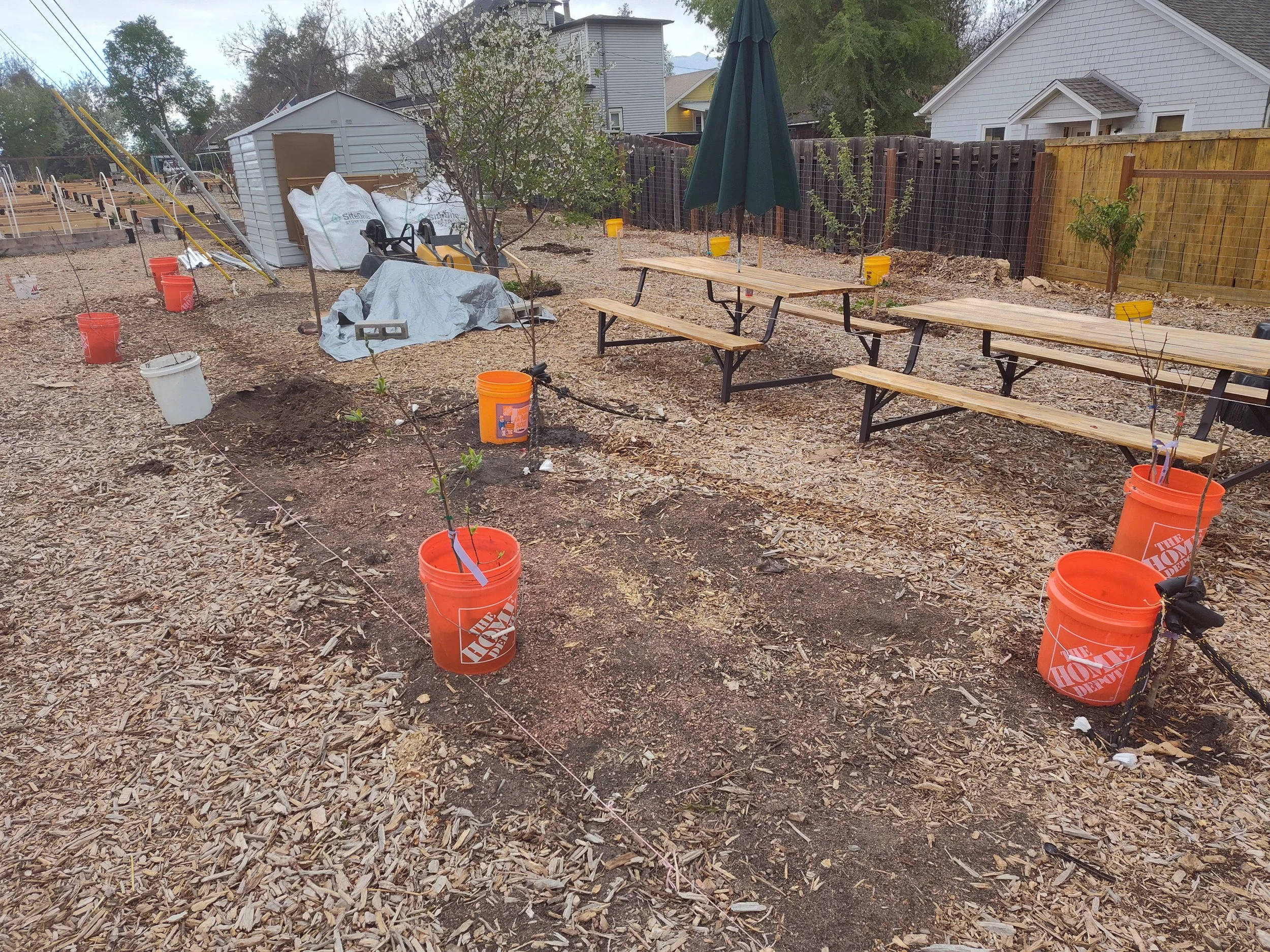
As we move into warmer, drier days, we’re asking gardeners to help care for our young food forest trees.
Each sapling has a 5-gallon bucket placed beside it that is part of a slow-release watering setup. It’s a pretty neat irrigation solution!
When you’re at the garden, please take a moment to refill any empty buckets you see. This helps ensure the young trees receive consistent moisture as they establish this season. It is almost humanly impossible to overwater them this year, so don’t hold back.
Don’t Miss the July 1st Deadline
Attention all garden members: the deadline for cultivating your plot is July 1st. If you find that you will not be able to meet this deadline, or if you know you won’t be able to garden this year, reach out to us.
Straw Mulch For Plots
Community Garden Members - if you’d like to straw mulch the top of your plot (we highly recommend this method as a biodegradable weed barrier and way to retain moisture), we’ll be dropping off several bales of straw. Find them next to the shed. Help yourself, but please refrain from using the straw to much pathways (we’ll use wood chips for pathways). To add an extra layer of water retention and weed barrier, consider putting down cardboard and a little compost before adding the mulch.
Burn Notice: Know Your Noxious Weeds
Noxious weeds are plants that are legally designated as harmful to public health, agriculture, recreation, wildlife, or property. Uproot them on site! We have two weed species that are noxious to Colorado that regularly make an appearance at the community garden:

Siberian Elm
Several traits make Siberian elms (Ulmus pumila) one of the most despicable invasive tree species around. A hardy, fast growing, prolific, mid-sized, deciduous tree / shrub, the Siberian Elm has few redeeming qualities.
Siberian elms outcompete other, more desirable species, uproot walls around yards, don’t age well (branch breakage is common), and exacerbate allergies too. The leaves look like a little, serrated mint leaves, about 1.5" to 2" long, symmetrical and cat's-eye shaped. It often has a taproot that’s longer than the above-ground parts. They produce a ton of seeds each spring that fly around, sprout up everywhere, and unless you get them that first season, they are very hard to pull.

Field Bindweed
Bindweed is considered one of the most noxious weeds in the world because it can be difficult to control.
Bindweed creates extensive root systems up to several yards below the ground. Repetitive digging and pulling every two to three weeks throughout the growing season will deplete the root system and provide control until our field bindweed mite colony is operational.
Absolutely don’t let it go to seed, and remove as much of the root system as possible when found. Any root portions left in the soil will re-sprout in about two weeks, so be sure to dispose of bindweed in the trash (not our compost!) and be prepared to weed the same area every three weeks.
Happy Gardening!